Building my first roadmap
Intro
For years I was simply spectacle to numerous roadmaps - both revealed (on paper) and unrevealed (in the head) that Product and Program Managers created. My job was always to contribute opinion and any insights, and sometimes I did influence the roadmap provided my arguments were strong. However, I never had an opportunity to build one myself from scratch. The first chance occurred in my most recent engagement as a Product Owner to build a roadmap for a SaaS product implementation in an enterprise for an important use case, and here are my thoughts
Lessons (in the order of importance)
A. Focusing on tackling assumptions first rather than building features
This might sound cliche but whenever there is a development team on standby hungry to build and deploy there is a never ending temptation to do the 'real' work i.e. coding. Once we give into this temptation to build a roadmap full of 'features' it automatically influences prioritization by focusing on knowns i.e. items for which requirements are clear, since they can be built quickly. Fortunately, working under guidance of a senior product owner I learned to deliberately focus and collaborate with the development / engineering team mainly to conduct research or to prototype in a sandbox at the most, by ruthlessly focusing on unknowns or big assumptions.
The biggest tasks / questions I would put forward to engineering were those for which the answers were typically 'Yes/No' rather than "show me" or "demo" this, which could be comfortably tackled later (once we had some idea about the least understood items)
- Does an API exist to send data or query info from a system?
- Can we customize the workflows so that we are able to do use our own process?
- Can we query data related to these attributes in order to prioritize attributes?
Due to this intentional behaviour, the focus automatically shifted to ambiguous / unknown or "we have no idea what that is or looks like" kind of items.
- What will be the modified process/workflow once we implement the new technology?
- What strategy will we use to get buy-in from stakeholders for this new process?
- How will we prioritize large pieces of effort so that we can target the 80-20 rule (instead of aiming for 100 on the first day itself)
B. Future Process is typically the least understood item
C. Sequencing items
D. Influence of Strategy on Roadmap
E. Other items
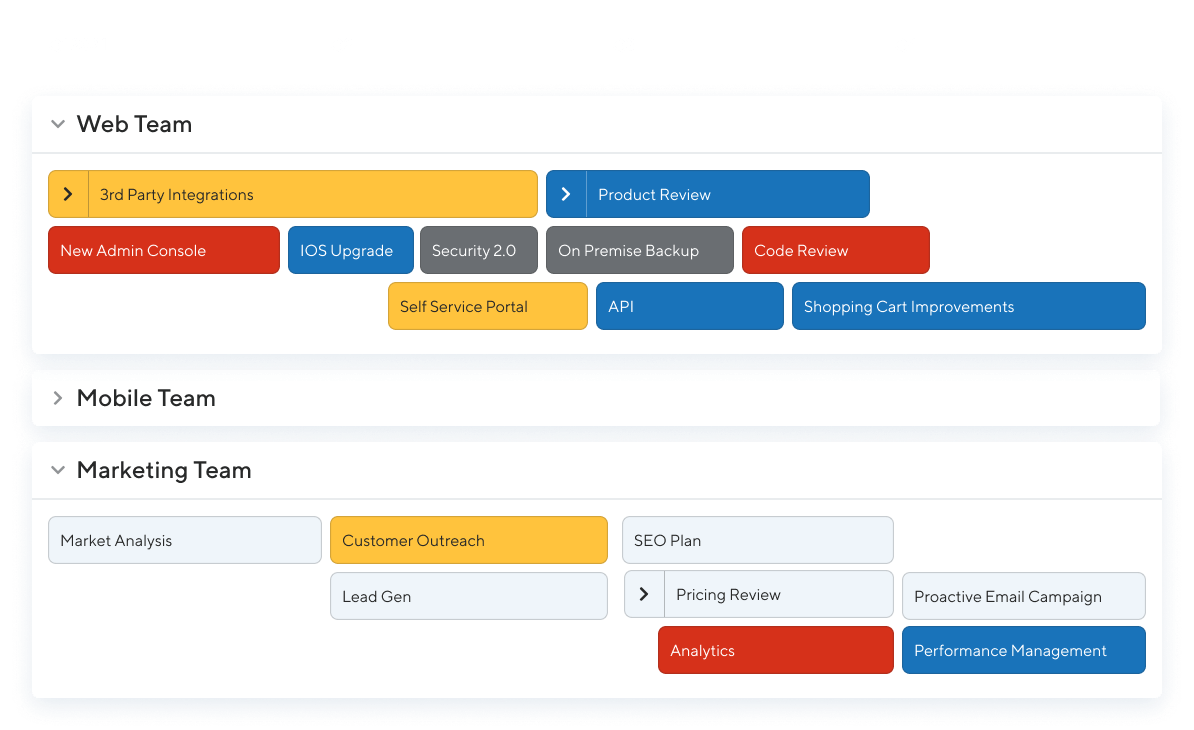
- Roadmap has swimlanes of themes or aspects
- The further along the fuzzier/fancier the Roadmap can be and that is perfectly normal. AI driven OS [2] 3 years down the lane..That's perfectly fine.
- Individual buy-in from key stakeholders especially Architects and Sponsors
- A balanced mix of known and unknown items for a Increment - Too many unknowns on plate at once will drive one nuts with anxiety.
Conclusion
References
- HomePage - Timeline@2x. https://www.productplan.com/uploads/Homepage-Timeline@2x.png
- A quote from the Telugu Movie Maharshi, 2019
- Marty Cagan, Inspired - How to create Tech Products Customers Love, Wiley, New Jersey, 2018
Comments
Post a Comment